Image: Hawaii News Now Video
How Dangerous Is Daniel K. Inouye Highway? What Recent Crashes Tell Us
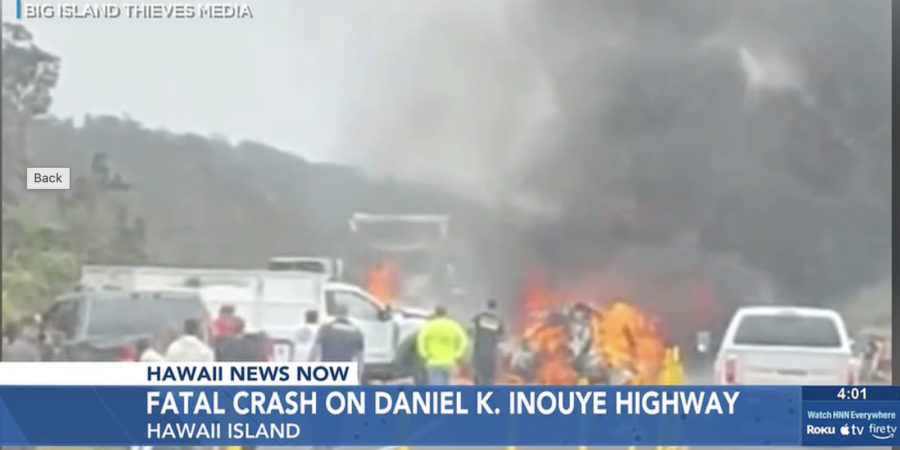
A fiery crash on Daniel K. Inouye Highway, also known as Saddle Road, shut down both lanes of traffic near mile marker 18 in early June. One person did not survive. It was the fifth death on this highway so far this year and the 15th traffic fatality on Hawaiʻi Island in 2026. For anyone who drives this road regularly, the news was painful but not surprising. Saddle Road has earned a reputation as one of the most dangerous stretches of pavement on the Big Island.
What Happened Near Mile Marker 18
According to police, a westbound 2003 Toyota 4Runner lost control while going through a curve on the highway. The vehicle hydroplaned across the center line into the opposite lane and was struck by an eastbound commercial truck. Both vehicles were badly damaged, and the Toyota caught fire. First responders found the driver trapped inside and unresponsive. That person was taken to the hospital and later pronounced dead.
Police said they do not believe speed or alcohol played a role in this particular crash. Wet pavement appears to have been the main factor. That detail matters because it points to a problem that goes beyond any one driver’s choices. The road itself, and the conditions drivers face on it, are part of the story.
A Highway With a Troubling Pattern
This crash was not an isolated event. Daniel K. Inouye Highway has seen repeated serious and fatal collisions over the past two years, many of them following a similar pattern.
In May 2026, two men died in a head-on crash near mile marker 26 after a car attempting to pass another vehicle collided with oncoming traffic. Just weeks earlier, another head-on crash claimed lives in North Hilo. In October 2025, a woman and her three-week-old granddaughter were killed near mile marker 25 when a pickup truck passing several vehicles at once struck an oncoming car head-on. Four other passengers in that car were seriously hurt. Back in March 2024, an 80-year-old woman lost her life at that same mile marker 25 stretch when a sedan crossed the center line while attempting to pass.
These are not random coincidences scattered across the island. They are clustered along specific stretches of a highway that local officials, residents, and families of crash victims have called dangerous for years.
Why This Stretch of Road Keeps Producing Tragedy
A few specific factors come up again and again when looking at crashes on this highway.
Narrow, Winding, Two-Lane Sections
Large sections of Daniel K. Inouye Highway remain a two-lane road with a 60-mile-per-hour speed limit. That speed limit was actually raised from 55 to 60 miles per hour back in 2017. Combine a higher speed limit with sharp curves, limited visibility, and passing zones that allow drivers to cross into oncoming traffic to overtake slower vehicles, and you get a setup where one mistake at speed can turn deadly in seconds. Several of the fatal crashes named above happened specifically because a driver attempted to pass on a stretch where doing so at highway speed left almost no room for error.
Weather and Drainage Problems
Heavy rain on the Big Island is common, and certain parts of Saddle Road do not drain well. Standing water on the roadway increases the risk of hydroplaning, which is exactly what investigators believe happened in the June 2026 crash. Local officials have specifically flagged sections of the highway, including areas around mile markers 13 to 16 and 44 to 47, as locations where poor drainage and pavement conditions raise the risk of a vehicle losing control in wet weather.
Speed and Distracted or Impaired Driving
Police have repeatedly pointed to speeding, distracted driving, and impaired driving as recurring contributing factors in serious crashes on this highway. Even on a well-built road, those behaviors are dangerous. On a road with sharp curves and limited passing visibility, they become especially deadly.
What Officials Are Doing About It
After this year’s spike in fatalities, the Hawaiʻi Police Department announced it would significantly increase enforcement along the highway, focusing on speeding, impaired driving, distracted driving, and seat belt violations. County officials have also asked the state to install solar-powered radar signs to encourage drivers to slow down, post warning signage near known crash hotspots, and inspect and repair drainage and pavement in the areas most prone to hydroplaning. Some lawmakers have pushed to lower the speed limit back to 55 miles per hour in certain stretches, though that effort has not yet succeeded. Plans are also underway to add rumble strips and eliminate some of the riskiest passing zones.
These are reasonable steps. Whether they happen quickly enough, and whether they go far enough, remains to be seen. In the meantime, the road carries the same risks it has carried for years.
What to Do If You or a Loved One Is Hurt in a Crash on This Highway
If you are involved in a crash on Daniel K. Inouye Highway, your safety comes first. Get medical attention right away, even if your injuries do not seem serious at first. Adrenaline can mask pain, and some injuries do not show symptoms for hours or even days.
Once you are safe, try to document what you can. Photos of the road conditions, the vehicles involved, and the surrounding area can matter a great deal later, especially on a highway where weather, road design, and driver behavior all play a role in how a crash happened. Get the names and contact information of any witnesses if you are able to. A police report will also be generated, and it is worth requesting a copy once it becomes available.
Crashes on this highway are rarely simple. Determining whether speed, weather, road conditions, or another driver’s actions caused the wreck often requires a careful look at the evidence, and sometimes more than one party shares responsibility.
Get Help After a Crash on Saddle Road
Daniel K. Inouye Highway has taken too many lives in too short a time. If you or someone you love has been hurt in a crash on this highway, you do not have to sort through what happened on your own. An experienced personal injury attorney can help you understand your options, deal with insurance companies, and pursue the compensation you may be entitled to for medical bills, lost income, and the pain this kind of crash leaves behind. Reach out today to talk through what happened and find out where you stand.